Dear investors,
By way of an update, I would like to update everyone on the current state of the financial markets. I have no idea if the egregious Russian attack on Ukraine symbolically represents the beginning of a new world order, whether it will be a transitory assault or the start of a new and larger scale expansionism by a Putin led government. Nor do I think anyone else does. Remember that on paper at least, Russia is a poor (1/3rd of the GNP per capita of Spain) corrupt, resource-rich, and dependent country. It has been having a lot of problems in the recent past, including low growth, miss-allocation of resources, and lack of inward investment during a period of capital leakage. I have recently mentioned the increased capital expenditure coming out of the current account; at this moment in time, we are seeing a frenzy leaving RUB, with many attempting to move into USD swaps. The problem going forward is the many sanctions from the west. We know that last summer, Russia completed its de-dollarization. The issue I am now seeing going forward is the issue of exchanging FX reserves for any developed FX. Given all FX reserves are electronic, this would require a western nation to agree to purchasing RUB. At this moment in time, I can’t see that happening. This is certainly a worry in terms of future RUB depreciation. We have just had a 20% hike from CBR, but I worry this will not prop up the currency until sanctions are lifted and FX volume gets back to pre-Ukraine levels.
Yes, of course, they have low government debt as a percentage of GDP and very high foreign reserves of about a half of GDP (around us $650 billion), but that won’t last long in the face of determined financial and other sanctions by the west. It would be wrong to underestimate the power of western democracies to inflict pain on Russia, even if the initial response to the invasion was somewhat half-heated. We continent to monitor the events coming out of Russia, one thing we can say with almost near certainty is that the commodity bull run is perhaps only just warming up with potentially a lot further to go. Now, of course, E&P is our chosen path, with the majority currently overweight this sector after we cherry-picked the majority of North Sea oilers and dated Brent due to its close proximity to Europe. I would also remind everyone that last week the UK energy ministry came out stating “north sea oil companies are due an inward investment.” I can say that the coming months will provide a great deal of safety in this sector due to natural gas and oil going through the roof.
Oh, and the agricultural revolution continues apace, and with Ukraine and Russian food production in potential turmoil and phosphate and other agricultural input prices rocketing, auguries for cell agriculture and precision fermentation just get better and better. Meanwhile, China, which accounts for more than half of worldwide coal production, continues to increase its output, overwhelming any efforts by the rest of us to reduce greenhouse gas emissions. Since there isn’t much in the short term to plug in the energy transition gap, the price of every type of fossil fuel has been forced to record or near-record levels, further fuelling the now-ingrained inflationary tendencies in the world economy. These inflationary tendencies, reinforced by very tight labour markets in most major economies, are not going away any time soon. In fact, they may even get worse as central banks refrain from the tightening path that some of them (main exception, China) have lately been on because of a misguided reaction to geopolitics.
But I would also like to cover some date concerning Russia’s economic integration with other countries and the importance of foreign economic relations for the country. Given news of recent sanctions from the west, there are many opportunities forming now that will directly affect profitability this year. For one, we turn to China, an increasingly significant economic partner for Russia. Up until a few days ago, the European Union remains Russia’s most important trading partner and is by far the most important source of foreign direct investment to Russia as well as sources of other financing. China’s importance to Russia has also increased, especially with respect to merchandise trade. Some more key figures have come to light. When we look at the import side, Russia’s imports of goods and services amounted to $380bn in 2021, which is around 25% of GDP. Machinery, equipment, and vehicles accounted for 40% of total imports. Other key product groups in imports were chemicals and food. Services accounted for 20% of total imports. In certain key manufacturing sectors, imports represented 55-75% if the value added in the sector’s final demand in 2018. The share of imports was highest in sectors of machinery & equipment and computers & electronics. Despite the import bans Russia imposed on select food categories in August 2014, the EU remains an important source of food imports for Russia. Balarus is also a big supplier of food imports for Russia, especially for product groups subject to import bans for Western countries. As we start to digest the sanctions coming from the west, many of these sectors are likely / or already seeing significant outward flows. We continue to now extend our commodity reach beyond usual markets, and we are now actively looking for new exposure in London wheat. More information will follow on this.
Perhaps most notably is the geographical distribution of Russian imports; this is surely an area that is global, but large chunks, as shown below, are coming from the EU and UK trade markets. With the world and NATO turning against Russia at this moment in time, will we see a complete shutdown in imports in the above sectors? You are more than likely going to see a knock-on effect for these companies. Unsurprisingly, the USD was used as the invoicing currency for around 40% of Russian import transactions; next is the EUR at around 30%. While the dollar dominated as the invoicing currency for the majority of Russian imports from EAEU countries. This will be very telling for FX flows in the coming weeks and even months as trades begin to form. This is by no means a death sentence for Russia, though as many are claiming it to be. We are already seeing pockets of inward investment and extreme deep value, though most notably we are seeing more shorting opportunities than longs.

As foreign flows begin to taper, I would like to remind everyone of previous FX flows at a time that was in practice similar to current day Russia from an economic point of view. Of course I am talking about summer 2021. As the de-dollarization took place, the JPY and CNY purchases got propped up as USD swaps began. The stock of foreign direct investment (FDI) in Russia was $480Bn, some 30% of GDP during June 2021. FDI statistics show that about 60% of that investment came from EU countries; I have a feeling they are not so keen to bolster this given the events that have since taken place. This, in our view, would be the perfect opportunity for China to step in and increase FDI flows. If we do see this in the coming months, you can likely expect CNY FX purchases to go through the roof in Russia.
On the notion of China, while Russia’s relations with western countries have deteriorated since 2013, economic relations between Russia and China have deepened. Nevertheless, their economic relationship is asymmetric. Russia is a far less important economic partner for China than vice versa. The sole exception is energy products. Russia is a significant, although not dominant – source of energy exports for China. We are preparing for a significant uptick in energy exports from Russia to China in the coming months as the relationship strengthens. More than likely, there will be a few key winners in this scenario. One is the shipping and logistics companies themselves; I am not talking about the oil production companies, but those that are contracted to ship said shipment. Getting data on deliverables can be tricky, but we are already looking into this, and in the coming months we should have a clearer plan to bring to the market for buying in preparation for an advancement in Russian exports into China. There have been several high-profile projects, such as the Power of Siberia natural gas pipeline and the Yamal LNG project, where Chinese funding has been crucial. If our analysis is right, we are clearly about to see Chinese funding grow. Both countries in recent years and even months have also promoted use of their national currencies in bilateral transactions to reduce the role of the USD. This has succeeded to some extent, but the limited convertibility of the Yuan and the volatility of the Ruble have hampered this trend. Now with the Ruble crashing, all attention will be on invoice currency to determine the primary FX ownership for such a transaction. I would imagine at this stage you could even see JPY from Russia’s point of view; with it being the worst performing G10 FX, it would certainly be a chance for Russia to bag a cheap FX rate. Of course, I am certain that some sort of back-hand deal would have to be done with China, as I am sure they would not be keen as to take ownership of JPY in the current climate, and whilst we did underpin the JPY weakness last year catching around 80% of the JPY decline against the USD, with further upside for commodities, JPY could be in for more pain. I have been monitoring JPY weekly inflows since November 2021; no safe-haven dash has appeared yet. Another aspect investors must consider is the trade relations between China and Russia; this has been built up over some time now, being their most important single trade partner. During the past decade, it has risen as the most important single trading partner for Russia. This mirrors the spectacular rise of China in global trade, as China has become the world’s largest goods exporting nation. In 2021, China accounted for 14% of Russian goods exports and 24% of imports. In contrast, Russia is not among China’s top trading partners, and Russia’s share in Chinese trade has practically not changed during the past decade. In Chinese goods exports, it has been around 2%, and in imports, about 3%. China imports mainly energy products from Russia. In these products, Russia is a more important source for the overall trade. Russia’s importance has grown in the past years with increasing transport infrastructure capacity for oil and natural gas between the countries and growing LNG production in Russia ( as LNG can be transported more flexibly to various markets). Transport infrastructure projects include the extension of the oil pipeline from Russia to China, the construction of the Power of Siberia gas pipeline, and Yamal.
I would certainly like to point out that the EU is the main export market for Russian oil and gas; this will not change anytime soon, and although it was uncanny that the UK energy ministry came out last week saying UK North Sea oil is due inward investment, we all know North Sea oil is simply not capable of running a well-oiled machine like the Russians do. Though clearly an inward injection of capital is no bad thing.
Find below an attachment of the current FX rate for USD/RUB.
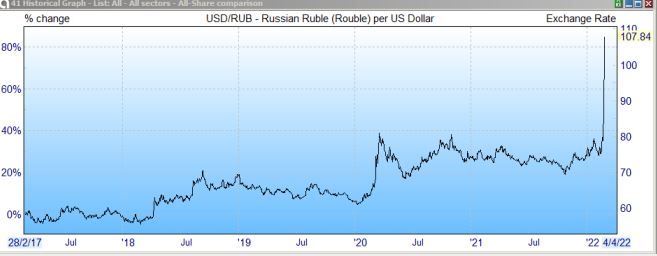
Clearly, in the near term, “sanctions” are hurting Russian denominated assets and preventing the CBT from deploying its electronic FX reserves by way of swaps in order to slowdown the RUB decline here. With no FX interventions today, unlike Friday or Thursday, today we saw rates increased to 20%. The Ruble is down roughly -30% today, and 1USD buys around 100 RUB. This will certainly keep inflation happy after the 9% figure we saw in January. Remember that at the end of January, the Bank of Russia’s international reserves amounted to $630 billion. Monetary gold accounted for over $132 billion, special drawing rights for $24 billion, and other positions in the IMF at around $5 billion. FX reserves amounted to over $468 billion. We continue to monitor the limited swaps hitting the marketplace, given the tremendous difficulty Russia is having in accessing its FX and gold reserves, we are very much in a free-fall state.
Lastly, I attach the most relevant OI for Crude.
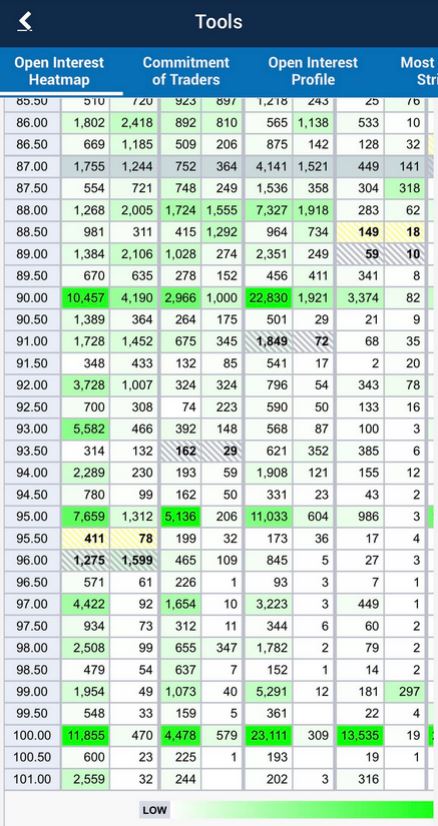
I would particularly like to point towards the current calls at $100; there appears to be very little in the way of inward selling pressure at this crucial level. As you all know, WTI hit $100 in the early morning Thursday session. Every $5 below we have a clear buying agenda that shows little sign of slowing down at the moment. As mentioned in our newsletter on Sunday, we have begun to see some large upward moves in E&P off the back of this. As we currently hold exposure in European natural gas and various oil vehicles, we see no reason to begin closing just yet.
I am sure that we do not need to remind anyone of the knock-on effect Emerging FX is going to see from this. Including anything from key exporters who will have their supplies cut to an outright immediate slowdown of Russian exports in various EM sovereign nations. Especially those nations with close ties to logistic companies that have been so dominant last year as commodities began rallying.