Dear investors,
This is an extract I wrote back when Brent was flirting with $95/bbl, at the time
we were up almost double on our investment. Why am I coming back to this
now? Well, currently there are some noticeable similarities once again forming.
Before we get into that, I will copy the extract I wrote back in 2022 here.
With Brent now flirting with $95bbl on Mondays open, I thought I would update
all the investors, given we also have Crude right around $92.50 today.
There are a few key updates on the US scene, particularly on the drilling scene. I am seeing US oil-directed drilling activity continue to have been on a steady
upward trend since the third quarter of 2020 but continues to significantly lag
pre-pandemic levels in late 2019 and early 2020. Based on Baker Hughes data,
the rig count for the week ending January 28, 2022, was 495, up 188% on the
August 2020 low of 172 and around a 21-month high. Compared with the recent
late 2018 peak of 873, the most recent reading is down 43%. Significantly, after
flattening in the closing weeks of 2021, the trend has strengthened noticeably.
Since the end of December 2021 with a gain of 15 rigs. Really the upward trend
here has been due to rapidly improving economics in the oil patch, which is still
providing plenty of headroom on a visà-vis fully accounted cost basis. Based on industry sources in the principal shale basins of the Mid-continent, these are typically in the range $30-50/barrel, including royalties. The second factor
supporting drilling, activity and the one least commented upon is the need to
offset natural depletion. In the tight reservoir basins producing light oil.
Depletion can run at very high rates of perhaps 60% in the year following
production start-up. This is much higher than where oil is conventionally
extracted. If the objective is to at least maintain production, there is no
alternative other than to maintain an intensive drilling and well completion
programe in shale or tight reservoir formations.
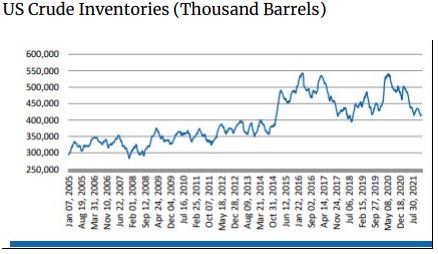
It is pretty clear here that inventories are at the lower end of the five-year range. The recent peak for US crude inventories was in March 2021 at 503mn barrels. Subsequently, there has been a sharp decline, and on January 21, 2022 it stood at 416.2mn barrels. This was at the lower end of the five-year average for the time of yea0,r but by no means a particularly low level from a longer term perspective.
On a days’ supply basis, crude inventories on January 21 stood at 26.7. Although, well down on the 32.6 of a year earlier, this was not totally surprising given that inventories were still bloated in early 2021. Looking at the period 2010 to 2021 and excluding the spike in the second quarter of 2020 associated with the Corona virus crisis, days’ supply have averaged around 25. Though still clearly pulling back in line with the much longer-term average, it is very much a tailwind for spot prices. It is pretty likely we can still see close to 104mmb/d for 2022; if this is achieved, this will beat the 2019 record of just over 100mmb/d. Peak demand is certainly not on the horizon and is pretty evident after the recent Q4 earnings report from Shell and across the board performance from the super-majors, as we rotate into E&P. I would like to address the surge today shortly in Hurricane Energy, up some 11% at the time of writing. I will address this separately to the U.K. clients on Monday after just having extremely positive results from the Lancaster Oil field.
OPEC spare capacity? From what we can see, there is little spare capacity from
OPEC for this year, with previous estimates looking pretty obsolete due to a
mixture of technical and operational factors. This school draws support from a
tendency for OPEC producers operating below quota in recent months. An
alternative school led by OPEC and the EIA argues that there is significant spare capacity. The EIA, indeed, argues that there is more spare capacity available now than the average of about 2.2mm b/d between 2012 and 2019. For context, spare capacity is defined by the EIA as the capacity that can be brought on-stream within 30 days and maintained for at least 30 days.
When we look at production economics, the surge in the recent months has
clearly transformed the economies of oil production in the US. With WTI and the Gulf Coast benchmark, Louisiana Light, in the high $80s/barrel, US-focused E&Ps able to capture these prices are now highly profitable and cash generative. In fact, we believe profitability is as high as it has ever been in the tight oil reservoir basins of Texas and the Mid-Continent since the shale revolution commenced ten or more years ago. Returns have been boosted not only by elevated prices but also significant declines in field development costs. EOG Resources, one of the largest US-focused E&Ps, for example, has indicated that its well costs in the Permian Basin Wolf camp formation have fallen from $7.8m in 2018 to prospectively $5.7m in 2021. This has been achieved by a combination of faster drilling times, improved well completion techniques, and procurement economies. Revealingly, EOG also claims that the break-even price to achieve a 10% ROCE (return on capital employed) in the Permian has been reduced from $83/barrel in 2014 to less than $47/barrel currently. Based on the current $92/$93bbl WTI pricing, you could quite easily say that Permian Basin cash margins net of royalty and production tax would be around $50bbl, or a hefty 75%. When you include depreciation, depletion, and amortization that would be closer to $40. Now in practice, wells in the Permian produce a mix of crude, gas, and NGLs, so some dilution should be accounted for.
Some technical’s coming out of the market here. See below:
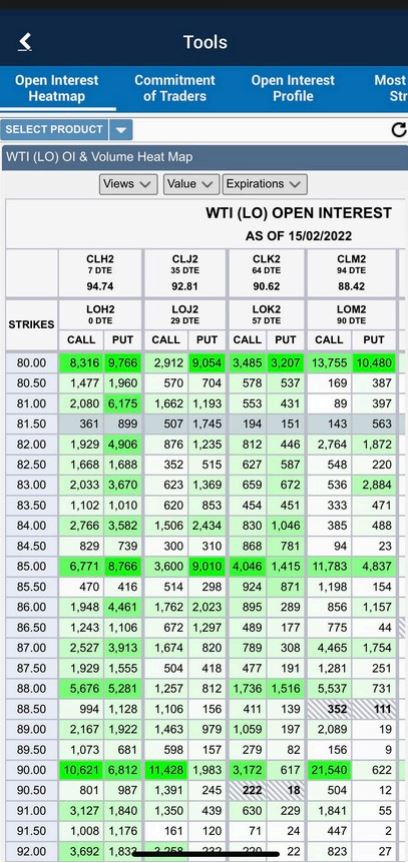
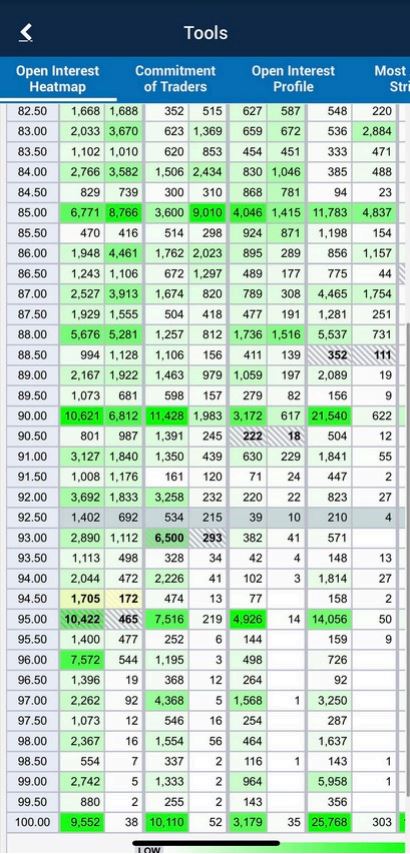
Take note of the current WTI contract CLH22 (March). I have attached some very notable strike prices in terms of open-interest ranging from $80 strike – $100 strike. Take particular interest in 90STRIKE. Significantly more buyers than sellers at this price point, almost 40% more buyers in fact. You can see even out at 100 strike we have at current, a near perfect balance for willing buyers to sellers; this is certainly quite significant. At those 5% premium levels, typically you would begin to see less willing to step in, that not being the case here at all for the majority of the strikes between 90 – 100. At 95STRIKE the ratio is near enough 10-1 Call/Put, something we haven’t seen in some months. I will attach the latest COT next week, but if last weeks is anything to go buy, there is a clear demand on the SWAP & Managed longs, even after the recent long reduction on the managed side. If we pair up this OI with the recent COT, total volume on the Puts would place the above as pretty significant for further support. I see no reason for us not to hold out for $96 Oil now, given that CLH22 is trading around $94.60 today and spot is around $92.60. Take note of the large STRIKE at 96 with 7,572 Call vs 544 Put, that would equate to spot being around $94 USD.
Leave a Reply